

AI software refers to programs designed to perform tasks that typically require human intelligence, such as data analysis, language processing, and automation. It enables businesses and individuals to improve efficiency, make smarter decisions, and automate repetitive work. The core value of AI software lies in its ability to harness large amounts of data and deliver actionable insights or automate complex processes.

These tools range from simple chatbots and virtual assistants to advanced machine learning platforms that cater to industries like healthcare, finance, and marketing. Users can choose from free or paid AI solutions depending on their needs, making AI accessible for various scales of application.
With the rapid development of AI technologies, selecting the right software requires understanding their capabilities, costs, and use cases. Exploring the top AI platforms and tools available in 2025 provides a clear picture of how organizations leverage artificial intelligence today. For more detailed insights, one can review comprehensive lists of the best AI software for various purposes at reliable technology sites like TechRadar.
Overview of AI tools and selection criteria
Choosing AI software requires clear criteria focused on functionality, reliability, and user needs. The evaluation includes factors such as ease of use, accuracy, cost, compliance, and ethical considerations.
Each AI tool must be assessed based on specific application contexts and performance metrics to ensure it meets the intended goals effectively.
How I selected the best AI productivity app in each category
The selection prioritized apps with proven accuracy, strong user interfaces, and comprehensive feature sets tailored to distinct tasks like writing, scheduling, or data analysis. Compatibility with existing workflows and integration capabilities were critical factors.
Security features such as data encryption and access controls were required to protect user information. Cost was balanced against functionality, emphasizing tools that offer scalable plans for individual and enterprise use.
User feedback and expert reviews helped verify claims about performance and usability. The final picks demonstrated consistent updates and support to address evolving technological and security challenges.
How I selected the AI software in this list
The selection process combined a structured review of technical specifications with an evaluation of legal and ethical compliance, such as bias mitigation and data protection policies. Each candidate underwent testing for accuracy and reliability on relevant tasks.
Ease of adoption and support resources were important for long-term success. This included clear documentation, vendor transparency, and active development communities.
Costs were evaluated for both upfront licensing and ongoing maintenance. The selection favored tools that provide transparency around pricing and vendor commitments to future improvements and security updates.
For more details on assessing AI tools based on key criteria, consult the guide on Evaluating AI Tools.
Best AI productivity tools by category

AI productivity tools serve specific purposes, streamlining work across diverse tasks such as writing, scheduling, design, and project management. These tools vary widely in function and are chosen based on precise needs like automation, content creation, or meeting support.
AI chatbots
AI chatbots assist with customer service, lead generation, and internal support. They use natural language understanding to provide instant responses, reducing the load on human agents. Popular options include tools with customizable workflows and multichannel support, enabling businesses to automate frequently asked questions and guide users efficiently.
AI search engines
AI search engines enhance information retrieval by understanding context and intent, not just keywords. They improve productivity by delivering precise, relevant results faster than traditional search. Advanced search tools integrate across team knowledge bases and external databases, offering features like semantic search and natural language queries.
AI apps for content creation
These tools help generate articles, marketing copy, and multimedia content quickly. They use large language models to replicate human writing styles or generate creative material. Features often include customizable tone, keyword optimization, and plagiarism checking, making them popular among marketers and writers.
AI apps for text enhancement
Text enhancement apps improve grammar, clarity, and style in writing. They provide suggestions for conciseness, tone adjustments, and error correction. Many also support multilingual text and integrate with email clients and word processors for smooth editing workflows.
AI apps for video generation and editing
These tools automate video creation using scripts and templates or enhance footage with AI-driven editing effects. They support tasks like cutting, color correction, and adding captions, reducing manual effort. Some specialize in generating video content from text input or converting presentations into video formats.
AI apps for image generation
Image generation AI creates visuals from textual descriptions or edit existing images. They are valuable for designers needing quick concepts or marketing teams producing graphics. Options offer varied styles and resolution outputs, including photo-realistic and artistic renditions.
AI apps for social media management
These tools schedule posts, analyze engagement, and suggest content improvements. They use AI to identify optimal posting times and trending topics. Integration with multiple platforms allows streamlined campaign management and automated response handling.
Voice and music generators
Voice generators produce natural-sounding speech for narration, support, or virtual assistants. Music generators compose background scores and soundtracks by analyzing style, mood, and genre preferences. Both categories offer customization to fit brand or content needs.
AI apps for knowledge management and grounding
These apps organize, classify, and retrieve organizational knowledge. They use AI to create searchable databases, link related documents, and provide real-time answers from company data, enhancing decision-making and collaboration.
AI task and project management
AI in task management predicts deadlines, assigns resources, and automates repetitive duties. It monitors project progress with data-driven insights and suggests schedule adjustments to improve efficiency. These tools often integrate with communication platforms.
AI transcription apps and meeting assistants
Transcription apps convert speech to text accurately for meeting records or interviews. Meeting assistants support scheduling, action item extraction, and follow-up reminders. They use AI to identify speakers and summarize content, saving time on manual note-taking.
AI apps for scheduling
Scheduling AI automates calendar management by finding optimal meeting times and handling reschedules. It integrates with multiple calendars and communication tools, reducing conflict and simplifying coordination.
AI apps for email and inbox management
These apps prioritize emails, suggest replies, and automate sorting. They reduce inbox clutter and help users focus on high-value messages. Features include smart filtering, unsubscribe management, and integration with task lists.
AI apps for presentations and slide decks
Presentation AI tools assist in designing slides, suggesting layouts, and generating speaker notes. They optimize visual appeal and content flow for clearer, more professional presentations, often supporting collaboration and version control.
AI apps for building a resume
Resume builders use AI to format content professionally and tailor it for specific jobs. They analyze job descriptions to highlight relevant skills and achievements, increasing the chances of passing applicant tracking systems.
AI apps for automation
Automation tools connect apps and workflows, enabling repetitive tasks like data entry and reporting to run automatically. They use triggers and conditions to execute sequences, boosting efficiency across departments.
The best AI assistants
AI assistants handle a wide range of personal and professional tasks including reminders, research, and communications. They use natural language commands and learn user preferences over time for improved support.
The best AI video generators
Top video generators create dynamic content from scripts or data inputs. They specialize in marketing videos, training demos, and social media formats, focusing on speed and ease of use.
The best AI image generators
Leading image generators deliver high-quality visuals using neural networks trained on extensive datasets. They allow style customization and support both creative and commercial applications.
The best AI meeting assistants
Meeting assistants automate minute-taking, action tracking, and participant engagement analysis. They integrate with video conferencing platforms to improve meeting productivity.
The best AI automation tools
The best automation tools offer broad integrations and user-friendly interfaces for building complex workflows without coding. They enhance task orchestration across cloud services and internal systems.
The best AI research tools
AI research tools aid information gathering, summarization, and citation management. They speed up literature review processes by extracting key insights from large document sets.
The best AI writing tools
AI writing tools cover drafting, editing, and ideation, supporting languages and tone adjustment. They are designed for bloggers, marketers, and business writers demanding accuracy and style.
The best AI design tools
Design tools assist in layout creation, prototyping, and branding by automating repetitive visual tasks. They integrate AI to suggest color palettes, typography, and user experience improvements.
The best AI app builders & coding tools
These tools generate code snippets, debug, and provide real-time suggestions. They cater to developers by increasing coding speed and reducing errors through AI-driven assistance.
The best AI knowledge management tools
Top knowledge management platforms use machine learning to classify and relate documents, offer smart search, and support corporate training and onboarding.
The best AI email assistants
Email assistants automate routine correspondence, enabling faster replies with contextual suggestions and follow-up tracking to maintain communication flow.
The best AI scheduling tools
High-quality scheduling AI minimizes conflicts and optimizes calendars, often incorporating predictive analytics for better time allocation.
The best AI presentation makers
Presentation makers simplify complex slide creation using AI to automate design and content structuring. They help users build visually appealing decks quickly.
The best AI resume builders
Resume builders feature AI-powered tailoring to specific job descriptions and automated formatting to improve professionalism and employer appeal.
The best AI voice generators
Voice generators create realistic speech with multiple accents and emotions, useful for narration and virtual assistants.
The best AI music generators
Music generators compose and customize tracks based on user input, supporting content creators needing unique audio under licensing control.
The best AI marketing tools
AI marketing tools optimize campaigns with data-driven insights, automate customer segmentation, and fine-tune messaging across platforms to boost engagement.
For more details on specific AI productivity tools and trending options, consult resources listing the best AI productivity tools in 2025 and comprehensive AI software by category.
Free AI tools and resources

Many AI tools offer extensive capabilities for developers, businesses, and researchers with no upfront cost. These tools focus on language processing, image analysis, speech recognition, video labeling, and cloud-based AI services. Users can access both foundational AI models and specialized applications to accelerate their projects.
Free AI tools from Google Cloud
Google Cloud provides a variety of AI tools accessible without charge within certain usage limits. These include APIs for vision, language, and video analysis, as well as tools for data labeling and machine learning. The free tier enables users to integrate AI into applications with reliable infrastructure and scalability.
Users can take advantage of Google Cloud’s consistent uptime and support for multiple programming languages. The platform facilitates building, deploying, and managing AI-powered applications efficiently. The free tier supports experimentation without financial risk, encouraging innovation.
Work with the latest AI models and turn your ideas into apps with free AI tools
Google Cloud offers pre-trained AI models and custom training options. These models handle tasks like image recognition, natural language understanding, and recommendation systems. Integrating these models into apps allows users to focus on business logic rather than AI training complexities.
Developers can deploy AI models directly through APIs or within containerized environments. This accelerates app development and reduces time-to-market. Access to cutting-edge models ensures applications leverage state-of-the-art AI capabilities.
Experiment, test, and discover the power of Gemini with Google AI Studio
Google AI Studio provides an interactive platform for experimenting with Gemini, a multi-modal AI model. Gemini combines capabilities in vision, language, and reasoning, allowing for versatile AI applications. Users can test Gemini’s performance, customize inputs, and analyze outputs online.
This tool helps developers and researchers evaluate Gemini’s potential before full integration. A user-friendly interface lowers the barrier to entry for advanced multi-modal machine learning. Gemini’s ability to blend text and images in responses makes it useful across sectors.
AI-powered language translation
Google’s AI translation tools support over 100 languages. They offer high-quality, real-time translations that can be integrated into websites, apps, and workflows. The models improve continuously through neural machine translation techniques.
Businesses use these tools for customer support, content localization, and cross-border communication. The APIs support text, speech, and document translation, ensuring flexibility. Translation accuracy and context understanding are strengths of Google’s AI-powered solutions.
AI image detection and analysis
Google Cloud’s vision AI services recognize objects, faces, landmarks, logos, and text within images. These tools support labeling, classification, and custom model training on image datasets. They enable automated image content moderation and metadata generation.
Applications include retail product identification, security monitoring, and media management. The APIs process images at scale and provide confidence scores for detected features. Developers can also detect inappropriate content automatically to ensure compliance.
Speech-to-text transcription
The speech-to-text API converts spoken language into accurate, machine-readable text. It supports multiple languages and dialects. This service is optimized for noisy environments and handles both short utterances and lengthy recordings.
Use cases include call center transcription, voice command interfaces, and media captioning. Real-time streaming transcription helps businesses improve accessibility and automate workflows. The API also supports punctuation and speaker diarization.
Text-to-speech generation
Google’s text-to-speech tools transform written text into natural-sounding audio. Multiple voices and languages are available, with options for customizing pitch, speed, and volume. This service caters to applications in education, accessibility, and virtual assistants.
It supports SSML (Speech Synthesis Markup Language) for fine-grained control over speech output. Text-to-speech functionalities enable dynamic content delivery and enhance user engagement. This API integrates easily into mobile and web applications.
Analyze unstructured text
Text analysis APIs extract structured data from unstructured text. Features include sentiment analysis, entity recognition, syntax parsing, and content classification. This helps users understand customer feedback, news articles, or social media posts.
The AI can identify key topics and relationships in large text corpora. It also detects language nuances and intent. Businesses utilize these tools for market research, compliance monitoring, and chatbot optimization.
Label and analyze video with AI
Video intelligence APIs enable automatic detection of objects, activities, and scenes within videos. They support shot change detection, explicit content moderation, and transcription alignment. This reduces manual effort in video indexing and content management.
Users can tag videos for efficient search and compliance monitoring. The tools analyze live streams and recorded footage alike. Video AI also supports generating metadata to improve content recommendations.
AI research assistants
Google offers AI-powered research assistants to help extract information from scientific literature and large datasets. These assistants summarize documents, identify trends, and suggest relevant references. They accelerate academic and industrial research workflows.
These assistants leverage natural language understanding to interact conversationally with users. They help synthesize complex information efficiently. Integration with Google Scholar and other knowledge bases enhances their functionality.
Get started with free AI tools
Google Cloud’s free tier provides access to over 20 products, including 10 AI tools, with monthly usage limits. This allows users to develop and deploy AI applications without initial investment. The free access covers a range of AI capabilities, from text analysis to video intelligence.
Businesses and developers can prototype strategies, evaluate tools, and scale gradually. The free tier fosters innovation by removing cost barriers for small projects and startups.
All customers can explore and assess Google Cloud with free usage of over 20 products, including 10 free AI tools, up to monthly limits
Every Google Cloud customer benefits from ongoing free usage quotas. This includes APIs for natural language, vision, translation, and more. The monthly limits are sufficient for moderate workloads and initial testing phases.
This consistent access helps maintain development continuity. Users can integrate AI capabilities steadily while monitoring resource consumption.
New customers get up to $300 in free credits to try Google Cloud AI products
New Google Cloud users receive $300 in credit valid for up to 90 days. This credit allows unrestricted access to AI services beyond free tier limits. It supports larger experimentations and prototype deployments.
This financial incentive encourages exploring Google Cloud’s comprehensive AI offerings. New users can test performance, scale, and cost efficiency without upfront expenditures.
Take free AI courses
Google provides free AI training through its learning platforms. Courses cover machine learning basics, AI ethics, and specific Google Cloud AI tools. These educational resources enable users to gain hands-on experience and certification.
Learning paths target developers, data scientists, and business professionals. Accessible tutorials, labs, and videos ensure practical understanding. These courses help users maximize the value of Google’s free AI tools.
AI in software development
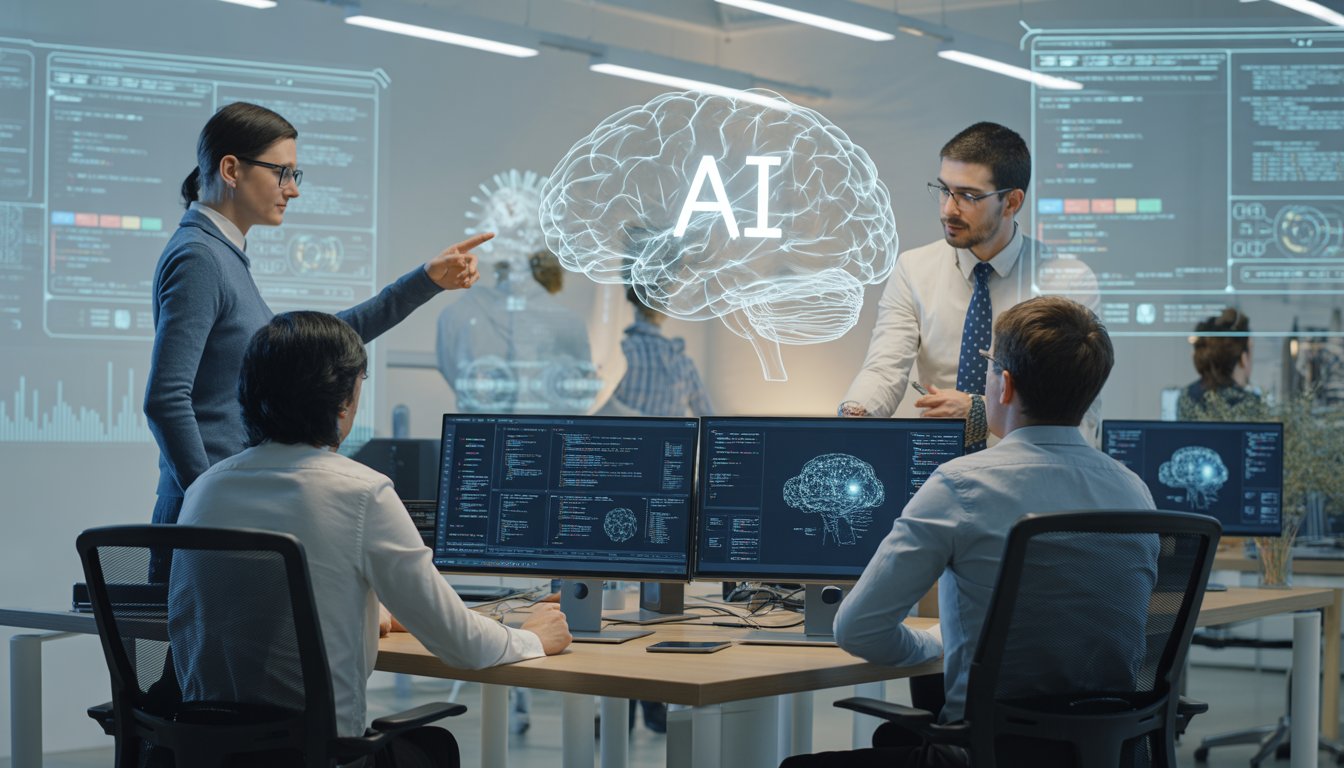
AI is reshaping software development by accelerating workflows, enhancing code accuracy, and automating routine tasks. It integrates deeply at every stage, from initial planning to maintenance, improving efficiency and innovation.
How AI is used in software development
AI is applied across tasks such as code generation, bug detection, testing automation, project management, and documentation creation. It helps analyze requirements, optimize software architecture, and personalize user experiences. Moreover, AI supports continuous improvement by learning from feedback and system performance data.
Developers use AI tools to automate routine coding, detect issues early, and optimize processes. These tools reduce manual errors, fast-track delivery times, and improve software quality. AI’s adaptability makes it valuable for both small projects and large, complex systems.
AI’s effect on the software development lifecycle (SDLC)
AI enhances multiple SDLC phases by automating low-value, repetitive tasks. During design and planning, AI analyzes user requirements and suggests architecture options. In development, it generates code snippets and facilitates collaboration.
Testing benefits from AI through automated test script creation and bug detection, shortening QA cycles. Deployment and maintenance use AI to monitor performance, manage updates, and improve reliability. This leads to faster releases and more stable software.
What AI means for software engineers
AI changes the engineer’s role by handling routine and error-prone tasks, allowing focus on complex problem-solving. Developers leverage AI assistants for code suggestions and validation.
Engineers need new skills to integrate AI effectively, such as understanding AI tools and interpreting AI-driven insights. They also take responsibility for overseeing AI outputs to ensure quality and ethical standards.
Who can use AI in software development
AI tools are accessible to software engineers, testers, project managers, and even stakeholders without coding expertise. Low-code and no-code platforms powered by AI open development to business analysts and product managers.
Enterprises use AI solutions to democratize software creation, enabling users with varied technical skills to contribute ideas, automate workflows, and customize products. This broadens participation and accelerates innovation.
Benefits of AI in software development
Key benefits include increased productivity, reduced coding errors, faster testing, and streamlined project management. AI improves accuracy by analyzing large codebases to identify potential bugs and performance issues.
Additionally, AI fosters improved collaboration via automatic documentation and status reporting. It reduces development costs by speeding up delivery and optimizing resource allocation, enhancing competitiveness.
Mitigating the potential risks of AI in software development
Risks involve overreliance on AI-generated code, bias in AI models, and security vulnerabilities. To mitigate these, human oversight is crucial at every stage.
Developers must validate AI outputs, maintain transparency in AI decisions, and update AI tools regularly to address flaws. Security-focused AI training reduces threats posed by automated code suggestions.
Code generation
AI generates code by interpreting natural language prompts or specifications. It speeds development by producing boilerplate code, complex algorithms, or entire functions.
Popular AI coding assistants use large language models to suggest relevant code snippets. Code generation increases efficiency but requires human review to avoid logic errors and maintain coding style consistency.
Bug detection and fixing
AI analyzes source code to identify defects, inconsistencies, and security flaws. It highlights problematic areas earlier than manual reviews, reducing debugging time.
Some AI tools suggest fixes by referencing known patterns or repositories. Automating bug detection accelerates QA cycles and improves software stability while allowing developers to concentrate on complex debugging tasks.
Testing automation
AI transforms testing by creating test scripts from requirements, updating tests in response to code changes, and prioritizing test cases based on risk assessment.
Automated testing shortens development cycles and increases coverage. AI-driven testing tools detect edge cases and performance bottlenecks that might be missed in manual testing, enhancing software reliability.
Project management
AI supports project management with predictive analytics that forecast timelines, resource needs, and risk factors. It automates routine scheduling and progress tracking.
AI tools provide real-time insights and recommend adjustments to keep projects on track. This enables proactive decision-making and improves communication between technical and non-technical stakeholders.
Documentation
AI tools generate and maintain documentation by analyzing code and user inputs. They produce API docs, user manuals, and update changelogs automatically.
Improved documentation quality accelerates onboarding, reduces knowledge silos, and enhances team collaboration. AI-driven documentation ensures accuracy and consistency without adding manual workload.
Refactoring and optimization
AI identifies inefficient code and recommends refactoring to improve performance and maintainability. It detects duplicated code, unused variables, and architectural bottlenecks.
Optimization suggestions can address speed, memory consumption, or scalability. Automation in refactoring reduces technical debt and keeps software adaptable to future requirements.
Security enhancement
AI enhances security by detecting vulnerabilities, suspicious code patterns, and potential attack vectors. It automates static and dynamic code analysis.
Security-focused AI tools continuously monitor software for threats and recommend patches. Integrating AI in security reduces breach risks and ensures compliance with industry standards.
DevOps and CI/CD pipelines
AI automates build, test, and deployment stages within DevOps workflows. It predicts build failures, optimizes resource allocation, and manages release schedules.
AI integration in continuous integration/continuous delivery pipelines accelerates release frequency and improves deployment success rates, enabling more reliable software delivery.
UX design
AI assists UX designers by analyzing user behavior data to suggest design improvements and personalize interfaces. It uses predictive models to enhance usability and accessibility.
Automated prototyping tools generate user interface layouts based on requirements. AI-driven UX increases user satisfaction and engagement through data-driven design decisions.
Architecture design
AI analyzes system requirements and constraints to propose optimal software architectures. It evaluates trade-offs between scalability, performance, and cost.
Architecture suggestions support decisions on modularization, service selection, and cloud deployment. AI aids in designing robust, maintainable systems aligned with business goals.
Requirement gathering and analysis
AI tools extract and analyze requirements from natural language inputs, documents, and user feedback. They detect ambiguous or conflicting requirements early.
Enhanced requirement analysis reduces miscommunication and ensures alignment with stakeholder needs. AI accelerates this phase by organizing and prioritizing requirements efficiently.
Design and planning
AI supports design by generating blueprints, workflows, and resource plans. It simulates development scenarios for risk assessment and timeline forecasting.
AI-driven planning adjusts dynamically as project parameters change, improving flexibility. This leads to more realistic timelines and resource use estimates.
Development
AI accelerates coding via autocomplete, code generation, and integration support. It assists in learning new frameworks and languages faster.
Developers receive context-aware suggestions that reduce syntax errors and improve code quality. Integration of AI aids in collaborative coding environments.
Testing
AI performs automated functional, regression, and performance testing. It adapts test coverage based on code changes and historical bug data.
AI enhances detection of subtle defects and reduces manual test effort. This improves release confidence and product stability.
Deployment
AI automates environment configuration, release scheduling, and rollbacks when failures occur. It monitors deployment health metrics in real time.
These capabilities reduce downtime and improve deployment success. AI ensures releases meet performance and availability targets.
Maintenance and support
AI analyzes logs and user reports to detect post-release issues swiftly. It automates patch suggestions and impact analysis.
Maintenance efficiency improves by prioritizing tasks based on root cause analysis. Support teams leverage AI chatbots to resolve common queries.
Feedback and continuous improvement
AI collects and analyzes user feedback, telemetry, and usage patterns to identify improvement areas. It supports A/B testing and feature prioritization.
Continuous learning from data enables software to evolve based on actual user needs and behavior, enhancing product relevance and quality.
Automation of repetitive tasks
AI automates coding, testing, integration, documentation, and deployment tasks to free developers for creative problem-solving and strategic work.
This reduces human error and accelerates timelines. Automation helps manage complex projects with consistent output quality.
Improved software quality
Through predictive analysis, bug detection, and testing, AI raises software quality by addressing issues earlier and more comprehensively.
Consistent code standards, enhanced test coverage, and faster feedback loops contribute to higher-quality releases and user satisfaction.
Faster decision-making and planning
AI’s data analysis and forecasting enable faster, more informed decisions in resource allocation, risk management, and scheduling.
This agility helps teams react promptly to challenges and optimize workflows to meet deadlines and goals.
Democratization of software development
AI-powered low-code/no-code platforms allow non-developers to create and modify software components, increasing participation across roles.
This democratization expands innovation capacity and shortens feedback cycles by involving diverse stakeholders directly in development.
Enhanced user experience and personalization
AI personalizes software interfaces and features based on user habits and preferences. It anticipates needs and adapts in real time.
Improved UX fosters higher engagement, satisfaction, and retention by delivering tailored interactions aligned with user expectations.
Enterprise AI software and solutions
Enterprise AI software enables businesses to improve efficiency, automate complex workflows, and enhance decision-making with tailored applications. These solutions span multiple industries, leveraging data and AI to solve domain-specific challenges and unlock new opportunities.
C3 AI Applications
C3 AI Applications focus on delivering industry-specific AI solutions that optimize operations and reduce costs. These applications address common enterprise needs such as predictive maintenance, fraud detection, supply chain optimization, and energy management.
They provide pre-built, scalable AI models that integrate seamlessly with existing enterprise systems. This approach shortens deployment times and delivers actionable insights quickly, supporting faster decision-making across departments.
C3 AI Software
C3 AI Software serves as a comprehensive platform for developing, deploying, and operating large-scale AI applications. It includes tools for data integration, model development, and application lifecycle management.
With built-in security and compliance features, this software supports cross-industry needs, ensuring enterprises can safely deploy AI at scale. It simplifies complex AI workflows using a unified architecture, reducing operational overhead.
What is Enterprise AI
Enterprise AI refers to the application of artificial intelligence technologies designed specifically for large organizations. It leverages machine learning, natural language processing, and data analytics to automate key business processes and improve overall efficiency.
This class of AI differs from general AI by emphasizing scalability, security, and integration with complex existing IT environments, enabling enterprises to generate measurable business value.
C3 Agentic AI Platform
The C3 Agentic AI Platform empowers autonomous decision-making through AI agents capable of executing complex workflows. These agents interact with enterprise data and systems to perform tasks without human intervention.
By simulating human judgment and continuous learning, the platform supports use cases such as automated risk assessment, customer support, and operational monitoring, reducing time and errors in routine processes.
C3 Generative AI
C3 Generative AI specializes in creating content, insights, and models by generating new data from existing datasets. It enhances creativity and productivity in areas like report generation, natural language queries, and scenario simulations.
This technology supports enterprises in transforming raw data into actionable knowledge, helping teams accelerate innovation and respond dynamically to market demands.
Manufacturing
In manufacturing, Enterprise AI targets process optimization, quality control, and predictive maintenance. AI-driven analytics reduce downtime by identifying equipment failures before they occur.
These solutions improve supply chain visibility and automate production scheduling, enhancing output and reducing costs. Enterprises benefit from increased operational efficiency and smarter resource allocation.
Oil & Gas
Enterprise AI in oil and gas focuses on asset integrity, exploration optimization, and environmental compliance. AI models analyze vast sensor data to predict equipment failures and optimize drilling operations.
It supports sustainability efforts by monitoring emissions and managing energy usage. These tools drive safer, cost-effective operations while navigating complex regulatory landscapes.
Utilities
Utilities leverage Enterprise AI for demand forecasting, grid management, and outage prevention. AI systems analyze consumption patterns and environmental data to optimize energy distribution.
This enables better load balancing and faster response to service disruptions. Additionally, AI helps utilities improve customer experience through personalized service offerings and billing accuracy.
Financial Services
AI solutions in financial services emphasize fraud detection, risk management, and customer personalization. Machine learning algorithms analyze transaction data to identify anomalies and predict credit risk.
Enterprises benefit from automated compliance reporting and enhanced portfolio management. This leads to improved regulatory adherence and more effective financial decision-making.
Defense & Intelligence
Enterprise AI supports defense and intelligence by enhancing threat detection, predictive analytics, and decision support. AI systems process large volumes of sensor and surveillance data to identify risks in real time.
It aids in strategic planning and resource deployment, improving operational readiness. Secure and compliant AI platforms are critical for handling sensitive government data.
Government
In government, Enterprise AI improves public service delivery, fraud prevention, and administrative automation. AI-driven platforms streamline processes such as license issuance, benefits management, and citizen engagement.
These solutions enhance transparency and reduce operational costs. They also support compliance with evolving regulatory requirements across agencies.
Life Sciences and Healthcare
AI in life sciences accelerates drug discovery, clinical trial optimization, and personalized medicine. Healthcare enterprises use AI for diagnostic imaging analysis, patient monitoring, and care coordination.
Advanced data models improve treatment outcomes and operational efficiency. Privacy and security remain paramount in these sensitive environments.
Retail
Enterprise AI transforms retail through inventory optimization, customer insights, and personalized marketing. AI-powered recommendation engines enhance product discovery and sales conversion.
AI systems also automate supply chain operations and demand forecasting. Retailers gain a competitive edge by delivering tailored customer experiences.
Telecommunications
Telecom enterprises apply AI for network optimization, predictive maintenance, and customer support automation. AI models analyze network traffic to prevent outages and manage capacity.
Automated chatbots and personalized plans improve customer satisfaction. These tools help reduce churn and operational expenses.
Transportation
In transportation, AI improves route planning, fleet management, and predictive maintenance. AI models enable dynamic scheduling and fuel efficiency optimization.
These solutions minimize delays and lower operational costs. Enterprises can also enhance safety through real-time monitoring and anomaly detection.
Proven results in weeks, not years
C3 AI Solutions emphasize rapid deployment and measurable outcomes. Their modular design and industry-specific applications allow enterprises to see tangible improvements within weeks.
This contrasts with traditional AI projects that often take years to deliver value. The focus on speed enables faster ROI and competitive advantage.
Take the next step
Enterprises interested in adopting AI solutions should assess their specific needs and existing infrastructure. Evaluating platforms like C3 AI for scalability, security, and ease of integration is key.
Investing in pilot projects with clear KPIs can demonstrate value quickly. Enterprises can explore more details about C3 AI software and applications to guide strategic AI adoption.
Google AI initiatives and responsible AI
Google’s AI efforts focus on practical benefits, cutting-edge research, and ethical development. It emphasizes responsible AI practices while delivering innovative tools and products to users and developers.
Discover how AI can be helpful, from work to everyday life
Google AI enhances daily tasks and professional workflows. It powers smart features in products like Google Workspace, improving productivity through automation and intelligent suggestions. AI assists in language translation, accessibility, and personalizing digital experiences, making technology more useful for diverse users.
By applying AI in search, assistants, and image recognition, Google aims to make information accessible and actionable. These applications help users accomplish tasks faster and with less effort, demonstrating concrete value in everyday and work environments.
Build with Google AI
Google offers developers tools and platforms to create AI-powered applications efficiently. Cloud AI services provide scalable infrastructure and APIs for vision, language, and conversational AI models. TensorFlow and Vertex AI enable custom model development, training, and deployment with integrated monitoring.
Google supports developers with documentation, tutorials, and best practices to integrate AI responsibly. This ecosystem helps businesses accelerate innovation while adhering to ethical and safety standards.
Tackling the most challenging problems in computer science
Google AI invests heavily in fundamental research areas like natural language understanding, computer vision, and reinforcement learning. It collaborates with academia and AI practitioners to push scientific boundaries and solve complex problems.
Projects addressing health diagnostics, climate modeling, and robotics exemplify its effort to apply AI advances to impactful domains. This research is often published openly, contributing to the broader AI community’s knowledge.
We’re building and deploying AI responsibly
Google commits to ethical AI grounded in principles of fairness, privacy, safety, and accountability. It integrates rigorous risk assessment frameworks aligned with standards like NIST for governance and compliance.
Teams use tools for bias detection, explainability, and performance monitoring throughout AI product lifecycles. This commitment aims to minimize harm and build public trust in AI technologies.
We’re committed to improving the lives of as many people as possible
Google prioritizes inclusivity and accessibility in AI design. AI features support languages globally, assist individuals with disabilities, and address social challenges such as misinformation and bias.
By scaling AI responsibly, Google strives to reach diverse populations and empower communities with beneficial technology, fostering equity and positive societal impact.
Get started
Google offers accessible entry points for AI novices and experts alike. Tutorials, educational materials, and free-tier cloud services allow users to experiment and learn at their own pace.
Interactive tools and user-friendly environments lower barriers for adopting AI in products, research, or business initiatives. This approach encourages wide participation in AI development.
Products
Google AI powers multiple products, including Google Assistant, Google Photos, and Google Translate. These leverage machine learning to provide smart features like voice recognition, image enhancement, and real-time language interpretation.
Product integrations showcase practical AI use cases that improve user experience with responsiveness and personalized assistance.
Build
Developers can construct AI systems using Google’s frameworks and APIs, such as TensorFlow, AutoML, and Cloud AI. These tools support training models on custom datasets and deploying them with scalable infrastructure.
Google also emphasizes tools for responsible deployment, enabling developers to build applications that meet ethical and security standards.
Try the latest models
Google provides access to state-of-the-art AI models via platforms like AI Hub and API services. Users can test models for natural language processing, computer vision, and more without requiring deep expertise.
This access facilitates innovation by democratizing AI technology and supporting rapid prototyping and experimentation.
Research
Google AI publishes regular research papers and maintains open-source projects to contribute to the knowledge base. Research topics include language models, fairness, privacy, and robust AI methods.
Collaborations with universities and institutions help advance the field, addressing both theoretical and applied challenges in AI development.
For more details on Google’s responsible AI initiatives, visit the page about Responsible AI at Google Cloud.
Frequently asked questions about AI tools
AI tools vary widely in functionality, pricing, and complexity. They serve purposes from automation and data analysis to content creation and customer support. Understanding the available options helps users select the most efficient solution for their specific needs.
What are the best AI tools available today?
The best AI tools in 2025 include those offering advanced machine learning, natural language processing, and automation capabilities. Tools like OpenAI’s GPT-4 excel in generating human-like text. Google’s Vertex AI provides scalable cloud-based machine learning services.
Other notable tools include IBM Watson for business analytics and Microsoft Azure AI, which integrates easily with existing enterprise systems. The choice depends on the user’s goals, such as content creation, data insight, or workflow automation.
A clear breakdown:
- Text generation: GPT-4, Claude
- Data analytics: IBM Watson, Google Vertex AI
- Automation: UiPath, Automation Anywhere
- Computer vision: AWS Rekognition, OpenCV
Which AI tools are free to use?
Many AI tools offer free tiers, especially for individual or low-scale use. For text and code generation, OpenAI provides limited free access to its GPT models. Google Colab allows users to run basic machine learning models in a free cloud environment.
Other free AI tools include:
- Hugging Face: Offers access to pre-trained models and datasets.
- Runway ML: Free tier for creative AI applications.
- ChatGPT Free version: Provides conversational AI with usage caps.
Free tools usually have limitations on the number of API calls, features, or cloud computing power. Users should verify terms to avoid unexpected charges.
What are the main types of AI tools?
AI tools generally fall into four main categories:
- Reactive AI: Responds to specific inputs without memory or learning (e.g., chess engines).
- Limited Memory AI: Learns from historical data to improve performance (e.g., recommendation systems).
- Theory of Mind AI: Still experimental, aims to understand human emotions and social interactions.
- Self-aware AI: Hypothetical future AI possessing self-awareness.
Most current AI tools operate as limited memory systems, supporting tasks like image recognition, natural language processing, and predictive analytics. Understanding this helps users set realistic expectations for tool capabilities and limitations. More details are available in the FAQ on AI tool types.
What is the most powerful AI tool right now?
The most powerful AI tools combine large-scale training data, advanced architectures, and scalable compute resources. GPT-4 is widely regarded as the leading natural language processing model for its broad versatility.
In specialized fields, tools like Google DeepMind’s AlphaFold revolutionize protein folding prediction, impacting science and medicine. Microsoft Azure AI and Google Cloud AI offer powerful platforms that integrate multiple AI capabilities at enterprise scale.
Power is defined not only by raw capability but also by adaptability, ease of integration, and continuous improvement through updates.
What are the top 5 AI platforms for productivity?
The top AI platforms for productivity focus on automation, data processing, and collaboration features. These include:
| Platform | Key Features | Target Users |
|---|---|---|
| Microsoft 365 Copilot | AI integration in Office apps for drafting emails, summarizing docs | Business professionals |
| Google Workspace AI | Smart compose, task automation, meeting transcripts | Teams and enterprises |
| Notion AI | AI-assisted content creation and project management | Creatives and teams |
| Zapier AI | Workflow automation connecting multiple apps | Small businesses |
| UiPath | Advanced robotic process automation (RPA) | Enterprises with repetitive tasks |
These platforms boost efficiency by automating repetitive tasks and enhancing decision-making through AI-generated insights.